


JAWS Force Iso-Lateral Chest Press
Original price was: $396.00.$99.99Current price is: $99.99.
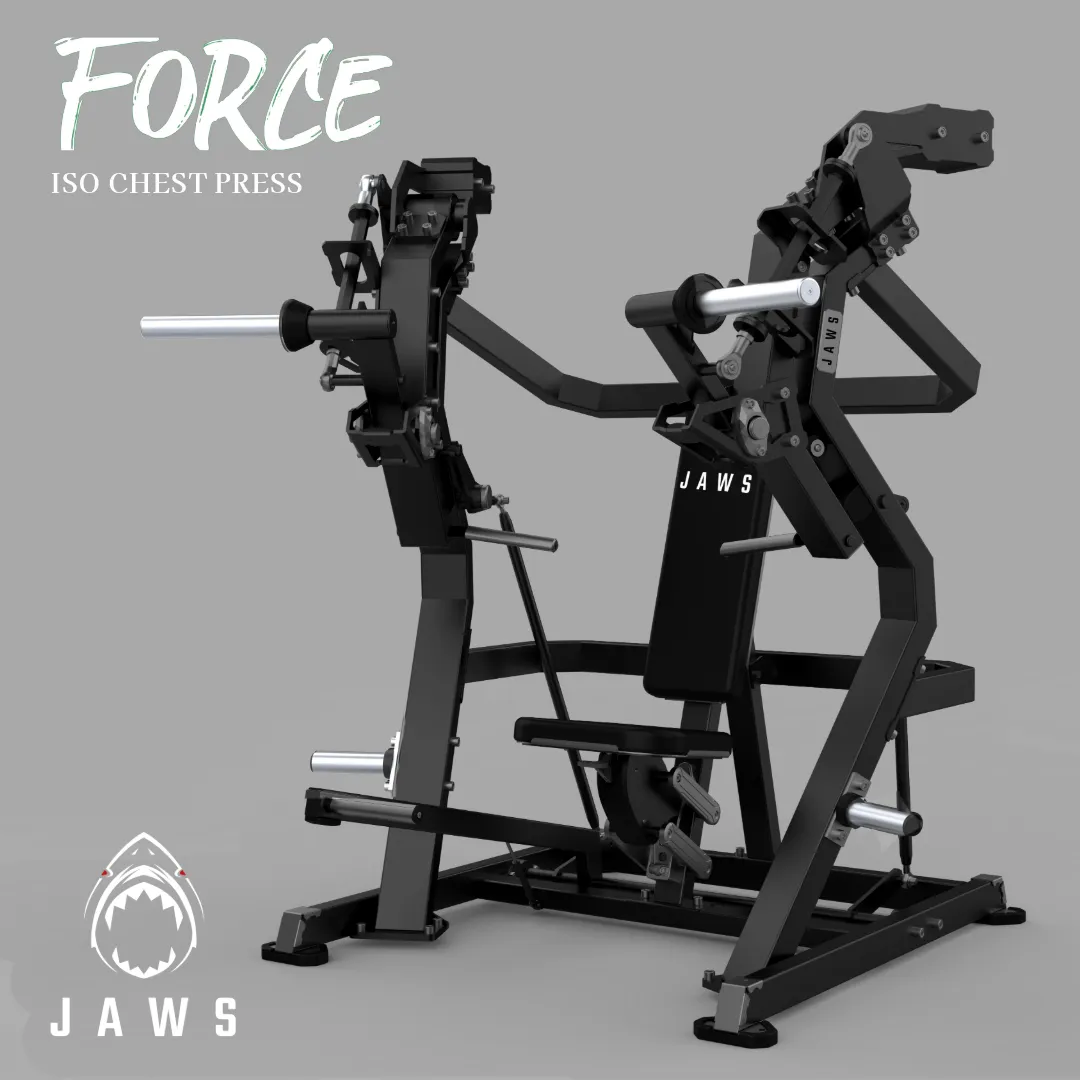
The JAWS Force Iso-Lateral Chest Press offers great comfort and muscle engagement. It has several standout features:
– Converging arms for increase muscle activation and comfort.
– Multi-link construction for consistent resistance curve.
– Movable seat and back-pad for different height users.
– Foot assist for an easy start-position and finish.
Add a personal touch to your gym: The machine comes in all-black, with a black frame and black upholstery. It is available and stocked in Bristol. We offer personalisation of both the frame and upholstery here in Bristol. Please add 2-3 weeks to your order time for these customised options. We also offer hand-delivery and assembly by our own team. Please see the drop-down menu’s for these optional extras.
- Get Quality, Get More
- Shop with Confidence, Pay Safely
- Free 1 year warranty period
- Online assistance, always at your service.

Benefits of the JAWS Isolateral Chest Press
Strength training is a crucial component of any fitness regimen, offering numerous benefits for both physical health and overall well-being. One exercise that stands out in the realm of upper body workouts is the isolateral chest press. This movement is not only effective for building strength but also for improving muscle balance and coordination.
In this article, we will delve into the benefits of the isolateral chest press, explore how it differs from traditional chest presses, and offer tips on how to incorporate it into your workout routine for optimal results.
Understanding the Isolateral Chest Press
The isolateral chest press is a strength training exercise that targets the muscles of the chest, shoulders, and triceps. Unlike the traditional chest press, which typically involves both arms moving in unison, the isolateral version allows each arm to move independently. This feature helps in addressing muscle imbalances and ensures that each side of the body develops evenly.
Using a machine designed for isolateral movements, this exercise can be easily integrated into a variety of workout routines, making it accessible for gym-goers of all levels.
Benefits of the Isolateral Chest Press
1. Corrects Muscle Imbalances
One of the most significant advantages of the isolateral chest press is its ability to correct muscle imbalances. In many exercises where both arms move together, the dominant side of the body often takes on more work, leading to uneven muscle development.
By allowing each arm to work independently, the isolateral chest press ensures that both sides of the chest, as well as the supporting muscles, are equally challenged. This balanced development not only enhances aesthetic symmetry but also reduces the risk of injury associated with muscle imbalances.
2. Enhances Muscle Activation
The isolateral chest press promotes greater muscle activation compared to the traditional chest press. With each arm working independently, stabilising muscles are engaged to a higher degree to maintain balance and control throughout the movement.
This increased muscle activation can lead to greater strength gains over time, as more muscle fibers are recruited during the exercise. It also helps in improving overall muscular endurance and control, benefiting other exercises and daily activities.
3. Improves Coordination and Stability
The independent movement of each arm during the isolateral chest press requires enhanced coordination and stability. As both sides of the body must work in harmony to perform the exercise correctly, the brain is challenged to develop better neuromuscular connections.
This improvement in coordination and stability translates to better performance in other exercises and sports, as well as in everyday tasks that require balance and precision.
4. Customisable Intensity
The isolateral chest press offers the flexibility to adjust the intensity of the workout according to individual fitness levels and goals. By utilising free weights, resistance can be easily increased or decreased to match personal strength levels.
This adaptability makes the isolateral chest press suitable for beginners looking to build foundational strength, as well as advanced lifters aiming to push their limits.
How to Perform the Isolateral Chest Press
To maximise the benefits of the isolateral chest press, it is essential to perform the exercise with proper form and technique. Here is a step-by-step guide:
- Setup: Begin by sitting on the isolateral chest press machine. Ensure your back is flat against the bench pad, and your feet are firmly planted on the ground when ready to initiate the movement*. *In the case of this JAWS machine, you have the added benefit of a foot assist to help you in to a comfortable start-position.
- Grip: Hold the handles an orthodox overhand grip, arms bent at a 90-degree angle, and elbows in line with your shoulders.
- Execution: Press one arm forward, extending it fully while keeping the other arm stationary. Focus on engaging your chest muscles during the movement. Slowly return to the starting position and repeat with the opposite arm. The aforementioned is for alternating chest presses. You can choose pressing both arms together simultaneously, alternating, or one arm and then the other. Or, a mix as you see fit. The workout choice is yours.
- Breathing: Inhale as you lower the weight back to the starting position and exhale as you press the weight forward.
- Repetitions: Aim for 8-12 repetitions per arm, adjusting the weight as needed to maintain proper form throughout the set.
Incorporating the Isolateral Chest Press into Your Workout
The isolateral chest press can be integrated into your workout routine in several ways, depending on your fitness goals and preferences. Here are some tips to help you get started:
- Warm-Up: Always begin your workout with a proper warm-up to prepare your muscles and joints for exercise. Dynamic stretches and light cardio can help increase blood flow and reduce the risk of injury.
- Frequency: Incorporate the isolateral chest press into your strength training routine 1-2 times per week. Allow adequate rest between sessions to promote muscle recovery and growth.
- Variety: Combine the isolateral chest press with other chest exercises, such as push-ups and bench presses, to ensure a well-rounded upper body workout. Dumbbells are another great choice, which can be performed isolaterally, also.
- Progression: Gradually increase the weight or resistance as your strength improves. This progressive overload will help you continue to make gains and prevent plateaus.
Conclusion
The isolateral chest press is a versatile and effective exercise that offers numerous benefits for strength training enthusiasts of all levels. By addressing muscle imbalances, enhancing muscle activation, and improving coordination, this exercise can help you achieve a balanced and powerful upper body.
Whether you’re new to strength training or a seasoned athlete, incorporating the isolateral chest press into your workout routine can lead to impressive gains in muscle strength, stability, and overall fitness. Give it a try and experience the transformative benefits for yourself.
Details of the JAWS Iso-Lateral Chest Press:
Arms: Converging handles.
Multi-link construction for consistent exercise resistence.
Adjustable seat and back pad for different height users comfort.
Weights Storage: 2x Posts as standard.
Dimensions (assembled): 1670 W x 1490 D x 1835 H mm
Machine Weight: 310kg
Transport box – plywood (oversized/ double-pallet): 1000 x 1650 x 700 (H) mm (GW: 350kg). Assembly required, unless requested otherwise.
Full-Commercial Use!
Manufacturer Warranty: Frame & welds = 10-years. Handles, guide rods, weight stacks, rotating bearings, rollers, cables = 1-year. Upholstery = 6-months. Excludes misuse and damage.
Made for use with olympic (2″/ 50mm) weight plates. Sold separately.
Made in all-black as standard. Customisation available on request at an additional charge. Please see drop-down menu selections.
| Custom Stock Status | Advance Order: Due end of September 2025. |
|---|
Be the first to review “JAWS Force Iso-Lateral Chest Press”
Related products
GYM EQUIPMENT
GYM EQUIPMENT

GYM EQUIPMENT
GYM EQUIPMENT
GYM EQUIPMENT
GYM EQUIPMENT
FLAT & ADJUSTABLE BENCHES
Reviews
There are no reviews yet.